
Integrated Automation for Medical Fluid Control Components
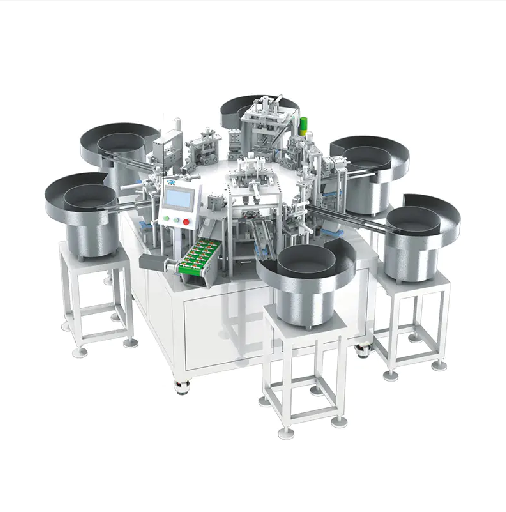
Medical fluid control components require carefully coordinated manufacturing processes because their internal structures and connections influence how they function within a medical device. Three-way valves may involve valve bodies, ports, internal moving elements, seals, connectors, and other components that must be assembled according to defined product specifications. A Fully Automated Production Line for Medical Three-Way Valves integrates material feeding, positioning, assembly, inspection, and process monitoring into a structured manufacturing workflow.
The first design consideration is the physical structure of the valve. Different models may have distinct port arrangements, internal passages, sealing structures, and connection features. These differences affect how components should be oriented and positioned during production. Automated equipment needs fixtures and tooling that hold each part securely while providing access for the required assembly operations. Accurate positioning helps maintain alignment between connected components and supports consistent manufacturing results.
Material selection also affects equipment design. Medical valve components may incorporate polymers, elastomers, or other materials with different hardness, elasticity, friction, and dimensional characteristics. Rigid valve bodies require stable positioning, while seals and flexible components may need controlled compression during assembly. Excessive mechanical force can damage sensitive parts or change their intended shape. Engineers therefore need to establish suitable handling methods and movement parameters based on product requirements.
Automated feeding systems help deliver individual components to the correct workstations. Conveyors, orientation mechanisms, feeders, and sensors can coordinate component supply while reducing unnecessary manual sorting. Because some valve parts may be small or have similar external shapes, feeding equipment should distinguish the required orientation and support reliable presentation to the assembly station. Consistent component delivery also helps maintain synchronization across the production line.
Assembly operations may involve inserting internal elements, fitting seals, connecting ports, or joining different valve components. The exact sequence depends on the product design and manufacturing process. Fixtures can stabilize the valve body while controlled actuators perform insertion or fitting movements. Sensors may confirm the presence and position of components before the next operation begins. These controls help reduce assembly errors associated with missing parts, incorrect orientation, or incomplete processing.
Inspection is particularly important for products that manage fluid pathways. Vision systems can examine component presence, external appearance, orientation, and assembly position. Additional testing methods may be required to assess dimensions, sealing performance, connection integrity, or flow-related characteristics, depending on the valve design and applicable product requirements. Inspection procedures should reflect established specifications rather than assuming that visual checks alone are sufficient to verify product quality.
Process control connects the equipment's mechanical operations and inspection functions. Programmable controllers can coordinate feeding, positioning, assembly, testing, and product transfer. Sensors provide feedback about component presence, actuator position, and equipment status. When an operation does not meet the configured conditions, the system can trigger an appropriate response. This structure helps manufacturers identify process deviations and maintain a clearer record of production activities.
Traceability can further strengthen quality management. Automated systems may collect information about production batches, inspection results, machine alarms, and operating events. These records help production and quality teams investigate issues and identify potential relationships between process conditions and product deviations. Well-organized data also supports maintenance planning and continuous improvement.
Equipment design should consider cleaning, maintenance, and operator safety from the beginning. Fixtures and contact surfaces need to suit the intended production environment, while machine guards help separate personnel from moving mechanisms. Maintenance access should allow technicians to inspect sensors, actuators, tooling, and transmission components. Clear operating procedures and suitable monitoring functions can support consistent daily operation.
Manufacturing flexibility becomes valuable when valve configurations or product requirements change. Modular assembly stations, adjustable fixtures, replaceable tooling, and configurable inspection functions can make selected processes easier to modify. Early planning helps engineers balance adaptability with mechanical stability and operational simplicity.
Effective medical valve automation combines product-specific engineering with material handling, precision assembly, process controls, inspection, and traceability. A Fully Automated Production Line for Medical Three-Way Valves can provide a coordinated framework for these activities when the equipment is designed around the valve's structure and quality requirements. AMBE TRADE develops automation-oriented solutions for medical manufacturing applications, with further information available at https://www.ambemedi.com/product/.

 Arabic
 French
 Spanish
 Portuguese
 Deutsch
 Turkish
 Dutch
Dutch
 Italiano
 Russian
 Romaian
 Portuguese (Brazil)
 Greek
Greek