
Why Are Consumer Drones Becoming More Popular?
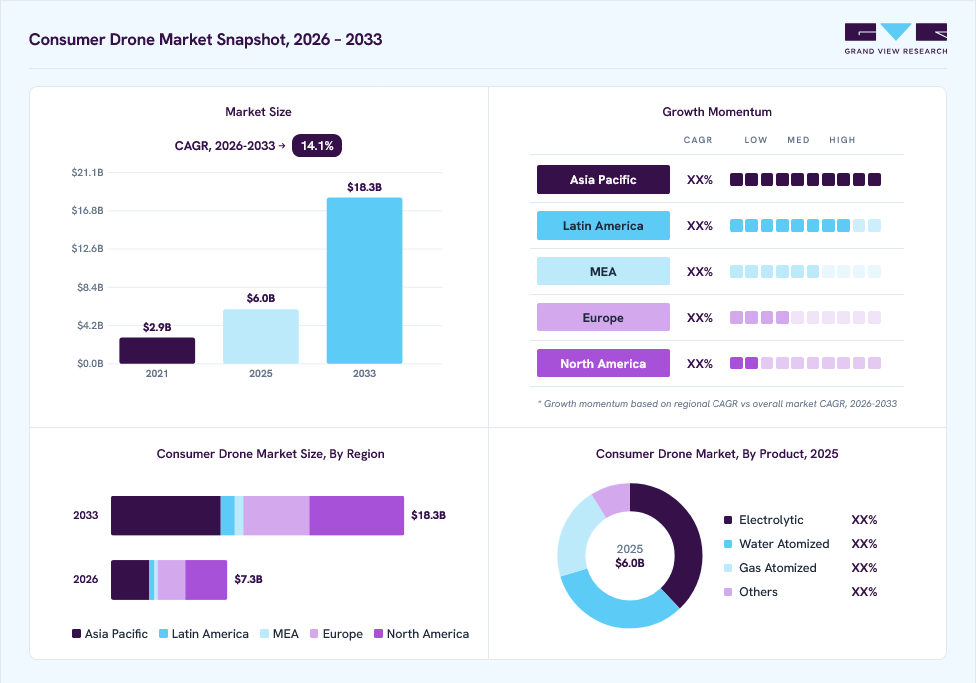
The growing popularity of aerial photography, recreational flying, and digital content creation is changing how consumers interact with drone technology. The Consumer Drone Market was valued at USD 6.0 billion in 2025 and is projected to reach USD 7.3 billion in 2026, before expanding to USD 18.3 billion by 2033, registering a 14.1% CAGR from 2026 to 2033. Rising demand for high-quality aerial imaging, AI-powered flight features, improved battery performance, and user-friendly drone systems is supporting continued market expansion.
Why Consumer Drones Are Becoming More Intelligent
Consumer drones are moving beyond basic recreational flying. Advances in artificial intelligence, computer vision, GPS navigation, autonomous flight, obstacle avoidance, and real-time image transmission are improving both usability and performance. These technologies allow drones to recognize objects, track subjects, stabilize footage, and assist users with flight operations.
The expansion of social media and creator-driven content is also increasing demand for compact drones capable of producing professional-looking aerial footage. Consumers are increasingly interested in drones that combine advanced imaging with simple controls, portability, longer flight duration, and seamless smartphone connectivity.
Multi-Rotor Drones Remain the Preferred Choice
Multi-rotor drones dominated the product category with a 69.4% revenue share in 2025. Their ability to take off and land vertically, maneuver precisely, and support aerial photography and filming makes them particularly suitable for consumer applications.
Multi-rotor platforms also benefit from increasing integration of high-resolution cameras, intelligent stabilization, autonomous flight features, and lightweight designs. Other products, including fixed-wing and hybrid drones, are projected to experience the fastest CAGR during the forecast period, supported by demand for longer flight endurance and specialized aerial imaging capabilities.
Hobby Flying Still Drives the Largest Demand
Toy/hobbyist applications accounted for 65.1% of revenue in 2025, making the segment the largest application category. Growing interest in recreational flying, drone racing, outdoor activities, and affordable beginner-friendly models continues to support adoption.
At the same time, the prosumer segment is expected to record the fastest CAGR through 2033. Professional photographers, videographers, independent filmmakers, and digital creators are increasingly using drones to capture cinematic aerial content. High-performance cameras, intelligent flight systems, and automation are helping expand this category beyond traditional hobby applications.
Content Creation Opens a New Growth Avenue
A major opportunity for the market lies in immersive content creation. Travel bloggers, social media creators, live streamers, and independent filmmakers are seeking new perspectives that conventional cameras cannot easily provide.
AI-assisted editing, cloud-based media sharing, augmented reality integration, first-person-view experiences, and intelligent flight automation are creating additional possibilities. Manufacturers can respond by developing compact, portable, affordable drones with advanced imaging capabilities and intuitive software ecosystems.
Technology Innovation Raises the Performance Bar
The market is characterized by a high degree of innovation. Manufacturers are focusing on AI-powered autonomous flight, obstacle avoidance, intelligent imaging, lightweight foldable designs, extended battery life, high-resolution cameras, and real-time video transmission.
Recent product developments demonstrate this direction. In March 2026, Insta360 announced the Antigravity A1, featuring built-in 8K 360 capture and FreeMotion technology. In January 2025, DJI launched DJI Flip, a vlog camera drone featuring foldable full-coverage propeller guards and a 1/1.3-inch CMOS sensor.
Regulation Remains a Key Market Constraint
Despite technological progress, stringent airspace regulations remain a significant restraint. Drone registration requirements, maximum flight-altitude restrictions, no-fly zones, remote identification rules, and operator compliance requirements can limit recreational use.
Privacy and aviation-safety concerns are also influencing regulatory frameworks. Frequent updates and varying compliance requirements can create uncertainty for consumers, while manufacturers must adapt software and product functionality to changing regulations.
The Next Phase of Consumer Drone Adoption
The market is projected to grow from USD 7.3 billion in 2026 to USD 18.3 billion by 2033, reflecting the continued expansion of consumer interest in aerial imaging, recreation, and content creation. AI-powered flight assistance, computer vision, improved cameras, connected applications, and compact designs are expected to remain central to product development.
As manufacturers make advanced capabilities easier to operate, consumer drones are increasingly positioned as accessible tools for photography, entertainment, digital storytelling, and personal exploration.
Frequently Asked Questions
What is driving the Consumer Drone Market?
Growing demand for aerial photography and videography, recreational flying, digital content creation, AI-powered flight systems, high-resolution imaging, and improved battery and navigation technologies are key growth factors.
Which segment leads the Consumer Drone Market?
Multi-rotor drones led the product category with a 69.4% revenue share in 2025, while toy/hobbyist applications accounted for the largest application share at 65.1%.
Key Consumer Drone Companies:
· 3DR, Inc.
· DJI
· eachine
· Zero Zero Robotics.
The growing need for accurate healthcare facility data and location-based intelligence is supporting demand for the U.S. Healthcare Facility Mapping & Intelligence Platform. These platforms help organizations map hospitals and healthcare facilities, analyze geographic coverage, and gain actionable insights for planning, market analysis, and healthcare service expansion
About us:
Grand View Research, a market research and consulting company, provides syndicated research reports, customized research reports, and consulting services. Grand View Research database is used by the world's renowned academic institutions and Fortune 500 companies to understand the global and regional business environment. Our database features thousands of statistics and in-depth analysis on 46 industries in 25 major countries worldwide.

 English
 Arabic
 French
 Spanish
 Portuguese
 Deutsch
 Turkish
 Dutch
Dutch
 Russian
 Romaian
 Portuguese (Brazil)
 Greek
Greek