


 Σχετικά
Advanced Clinical Learning Technologies Propel Medical Simulation Demand
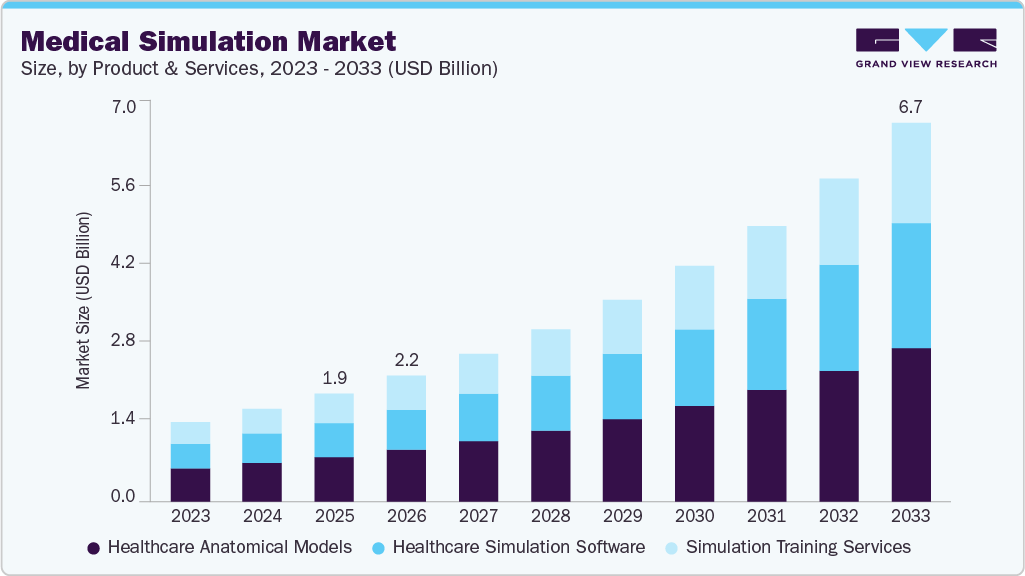
The medical simulation market is witnessing rapid expansion as healthcare systems across the world increasingly prioritize patient safety, clinical efficiency, and advanced workforce training solutions. The global medical simulation market size was estimated at USD 1.9 billion in 2025 and is expected to reach USD 6.7 billion by 2033, growing at a CAGR of 17.0% from 2026 to 2033. The growth is driven by a growing emphasis on patient safety and outcomes, a shortage of qualified healthcare professionals, rising use of simulation with a growing demand for innovative and custom training approaches to prevent medical errors, limited access to patients for educational and clinical development purposes, and growing investments in simulation-based healthcare education and training infrastructure. As healthcare institutions continue modernizing learning environments, simulation technologies are becoming critical tools for improving clinical accuracy, surgical precision, and emergency response preparedness.
The shortage of qualified healthcare professionals is a significant driver for the industry, as healthcare systems increasingly rely on simulation-based training to enhance clinical competency, reduce medical errors, and accelerate workforce readiness. Medical simulation solutions are enabling healthcare professionals to gain hands-on experience in risk-free environments, improving both technical and decision-making skills. Hospitals, academic institutes, and healthcare organizations are integrating advanced technologies such as 3D printing, virtual reality, and high-fidelity simulators into their educational programs to address the growing complexity of patient care. In addition, increasing investments in healthcare education infrastructure and digital learning platforms are supporting the broader adoption of simulation-based learning models across developed and emerging economies.
Key Market Trends & Insights
· North America dominated the market with a revenue share of 46.3% in 2025. The region’s leadership is supported by advanced healthcare infrastructure, strong investments in medical education technologies, and early adoption of simulation-based learning systems. Healthcare providers across the region are increasingly implementing simulation solutions to improve patient outcomes and enhance practitioner training efficiency.
· The Asia Pacific market is anticipated to grow at the fastest CAGR of 18.2% from 2026 to 2033. Rising healthcare expenditure, rapid expansion of medical education institutions, and increasing awareness regarding patient safety standards are contributing to regional growth. Countries across Asia Pacific are also investing heavily in healthcare workforce development and digital training ecosystems to meet rising healthcare demands.
· Based on product & service, the healthcare anatomical models segment led the market with the largest revenue share of 41.4% in 2025. These models are widely utilized across medical schools, nursing institutions, and healthcare training centers for anatomical learning and procedural practice. Their effectiveness in improving visualization and practical understanding continues to support segment growth.
· Based on technology, 3D Printing held the largest market share in 2025. The adoption of 3D printing technology is transforming medical simulation by enabling the creation of realistic anatomical structures and patient-specific training models. This technology is helping healthcare professionals practice complex procedures with greater precision while improving cost efficiency and customization capabilities.
· Based on end use, academic institutes held the largest market share in 2025. Educational institutions are increasingly adopting simulation-based learning to provide students with hands-on clinical exposure in controlled environments. The integration of advanced simulation platforms into medical curricula is helping institutions improve competency development, practical learning, and overall educational outcomes.
Looking for more specific insights? Customize this report to suite your business needs
Key Companies & Market Share Insights
The companies in the medical simulation market are actively involved in various strategic initiatives, such as partnerships, product launches, and acquisitions. Some of the strong players in the medical simulation market are CAE, Inc., Laerdal Medical, and Surgical Science Sweden AB. These companies offer a variety of medical simulation products to cater to diverse healthcare domains, such as training, emergency care, nursing and patient care, and catheterization, among others.
Key Medical Simulation Companies:
· CAE, Inc. (Madison Industries acquired the CAE healthcare division in October 2023)
· Laerdal Medical
· Simulab Corporation
· Limbs & Things Ltd
· Simulaids
· Kyoto Kagaku Co., Ltd
· Gaumard Scientific
· Mentice
· Surgical Science Sweden AB (Intelligent Ultrasound in 2025)
· Operative Experience, Inc.
· Cardionics, Inc.
· VirtaMed AG
· SYNBONE AG
· IngMar Medical
· TruCorp
· KaVo Dental
· Simendo
· Haag-Streit
· Symgery
· HRV Simulation
· Synaptive Medical
· Inovus Limited
Grand View Research offers
· Focused market intelligence reports on specific geographies or high-growth segments.
· Extended forecast timelines for long-term planning.
· Competitor Benchmarking and Supply Chain Analysis
· Inclusion of regulatory and policy assessments.
· Inclusion of custom data models, KPIs, or applications unique to your business
· Specific high-impact Data Decks and Tables to support effective decision making
· And much more…
Looking for a report customized to your requirements? Explore our Custom Research Offering

 English
 Arabic
 French
 Spanish
 Portuguese
 Deutsch
 Turkish
 Dutch
Dutch
 Italiano
 Russian
 Romaian
 Portuguese (Brazil)