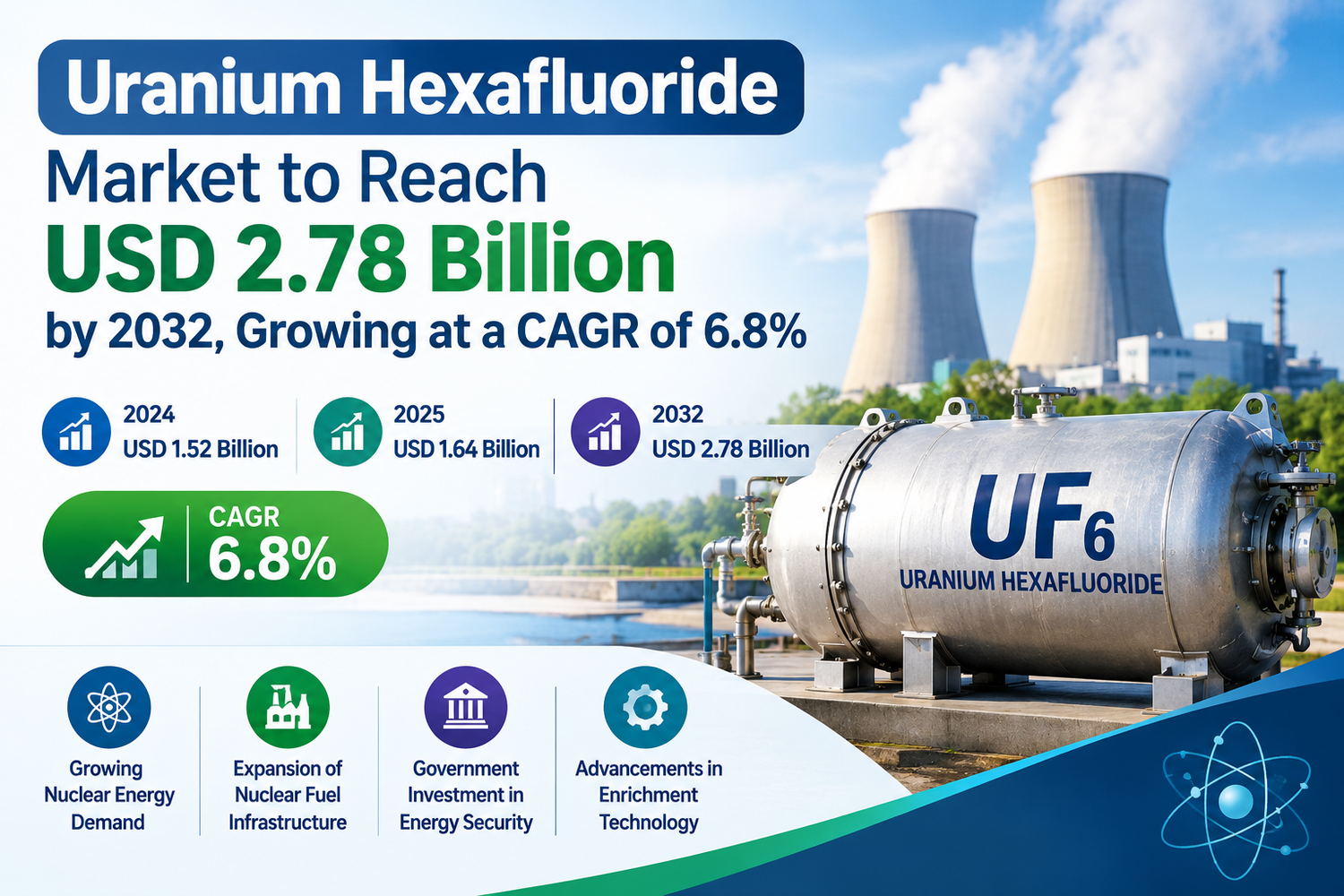
Uranium Hexafluoride Market to Reach USD 2.78 Billion by 2032 at 6.8% CAGR

Global Uranium Hexafluoride Market is gaining attention across nuclear energy, nuclear fuel production, uranium enrichment, isotope separation, and nuclear research applications. Uranium hexafluoride (UF₆) is a chemical compound used as an intermediate material in the nuclear fuel cycle. Its ability to transition into a gaseous state under controlled conditions makes it suitable for uranium enrichment processes used in nuclear fuel production.
According to 24ChemicalResearch, the global uranium hexafluoride market was valued at USD 1.52 billion in 2024 and is projected to grow from USD 1.64 billion in 2025 to USD 2.78 billion by 2032, registering a CAGR of 6.8% during the forecast period. Market growth is supported by increasing nuclear power generation, government investment in nuclear energy infrastructure, expanding nuclear fuel supply chains, and growing interest in low-carbon electricity generation.
Read the Complete Uranium Hexafluoride Market Report:
https://www.24chemicalresearch.com/reports/273949/global-uranium-hexafluoride-market
Uranium Hexafluoride Market Overview
Uranium hexafluoride plays an important role in the nuclear fuel supply chain by connecting uranium conversion processes with enrichment operations. It is used as feedstock for uranium enrichment, which produces material suitable for different nuclear fuel applications.
The market encompasses different uranium hexafluoride categories, including natural, reprocessed, and depleted material. Demand is associated with nuclear fuel production, isotope separation, research and development, and other specialized applications connected to the nuclear industry.
Increasing investment in nuclear power generation is strengthening interest in reliable nuclear fuel supply chains. Countries seeking to diversify their energy sources and reduce carbon emissions are evaluating nuclear power as part of their long-term electricity strategies.
At the same time, the uranium hexafluoride industry operates under strict regulatory and safety requirements. Production facilities, transportation systems, and enrichment operations require specialized infrastructure, technical expertise, and compliance with applicable nuclear material regulations.
What Is Driving the Uranium Hexafluoride Market?
1. Growing Demand for Nuclear Energy
The global focus on low-carbon electricity generation is supporting renewed interest in nuclear power. Existing nuclear reactors require dependable fuel supplies, while new reactor construction creates additional demand for materials used in the nuclear fuel cycle.
As countries expand nuclear energy capacity and extend the operating lives of existing plants, demand for uranium conversion and enrichment services is expected to support the uranium hexafluoride market.
2. Expansion of Nuclear Fuel Infrastructure
Investment in uranium conversion facilities, enrichment capacity, and nuclear fuel manufacturing is creating opportunities across the uranium hexafluoride supply chain.
Improvements to existing facilities and the development of additional processing capacity can help address supply requirements associated with expanding nuclear power programs. Reliable conversion infrastructure is particularly important because UF₆ serves as an intermediate material in uranium enrichment.
3. Government Investment in Nuclear Energy Security
Governments are increasingly focused on maintaining reliable nuclear fuel supplies and reducing vulnerabilities in international supply chains.
Strategic uranium inventories, long-term procurement contracts, and investment in domestic nuclear fuel infrastructure can support market stability. These initiatives may also encourage the development of additional conversion capacity and partnerships among nuclear fuel suppliers.
4. Technological Advancements in Enrichment Processes
Developments in uranium enrichment technology are influencing the broader uranium hexafluoride market. Improvements in process efficiency, automation, and monitoring systems can support more consistent operations and better resource utilization.
Advances in nuclear fuel technology and the development of new reactor designs may also influence future requirements for conversion, enrichment, and specialized nuclear fuel materials.
Read the Complete Report:
https://www.24chemicalresearch.com/reports/273949/global-uranium-hexafluoride-market
Manufacturing Costs and Market Challenges
The uranium hexafluoride market faces several challenges associated with regulatory compliance, raw material price volatility, infrastructure limitations, and specialized handling requirements.
Stringent Regulatory Requirements
Uranium hexafluoride production and transportation are subject to strict safety, security, and regulatory requirements. Facilities must maintain appropriate controls, specialized equipment, material-accounting procedures, and trained personnel.
These requirements increase operating expenses and create barriers for new market participants seeking to establish conversion or processing facilities.
Fluctuating Uranium Prices
Changes in uranium prices can influence procurement strategies, production planning, and investment decisions across the nuclear fuel supply chain.
Price uncertainty may complicate long-term planning for conversion facilities and fuel suppliers, particularly when major infrastructure projects require substantial capital investment.
Infrastructure and Supply Chain Limitations
The number of facilities capable of processing uranium into uranium hexafluoride is limited compared with many conventional chemical manufacturing industries. This concentration can create supply chain vulnerabilities when facilities experience operational disruptions or when international transportation becomes more difficult.
Developing additional capacity requires substantial investment, technical expertise, and regulatory approval.
Environmental and Safety Concerns
Uranium hexafluoride requires specialized handling because of its chemical hazards and the radiological considerations associated with uranium-bearing materials.
Maintaining safe operations, meeting environmental requirements, and addressing public concerns about nuclear facilities remain important responsibilities for industry participants.
Where Are the Opportunities in the Uranium Hexafluoride Market?
Expansion of Nuclear Power Programs
The development of new nuclear power plants and the continued operation of existing reactors create opportunities for uranium hexafluoride suppliers.
Countries investing in nuclear energy infrastructure require reliable access to nuclear fuel materials and related processing services. Suppliers capable of meeting demanding quality and regulatory requirements may benefit from these investments.
Small Modular Reactor Development
Small modular reactors are attracting attention as an emerging approach to nuclear power generation. Their development could create additional requirements across the nuclear fuel supply chain as projects progress toward deployment.
The potential market impact will depend on reactor designs, fuel specifications, commercialization schedules, and the development of supporting infrastructure.
Investment in Domestic Conversion Capacity
Geopolitical uncertainty and concerns about concentrated supply chains are encouraging some countries to explore additional domestic nuclear fuel processing capabilities.
Investments in uranium conversion infrastructure and regional supply partnerships may create opportunities for companies with the technical expertise and regulatory capabilities needed to support these projects.
Advancements in Nuclear Fuel Technology
Developments in enrichment technologies and advanced reactor systems may create demand for specialized nuclear fuel materials and improved processing capabilities.
Companies investing in research, process efficiency, and supply chain reliability may be better positioned to respond to changing requirements across the nuclear energy industry.
Download the Free Sample Report:
https://www.24chemicalresearch.com/reports/273949/global-uranium-hexafluoride-market
Uranium Hexafluoride Market Segmentation
The global uranium hexafluoride market can be analyzed by type, application, end user, purity grade, and supply chain stage.
By Type
-
Natural UF₆
-
Reprocessed UF₆
-
Depleted UF₆
Natural UF₆ is an important market category because uranium hexafluoride produced from natural uranium serves as feedstock for enrichment processes used in conventional nuclear fuel production.
Reprocessed and depleted uranium materials serve different purposes within the broader nuclear fuel cycle. Their applications depend on material characteristics, processing requirements, and the capabilities of the facilities handling them.
By Application
-
Nuclear Fuel Production
-
Isotope Separation
-
Research and Development
-
Others
Nuclear Fuel Production is the primary application segment because uranium hexafluoride is used in the enrichment process that supplies material for nuclear reactor fuel.
Demand in this segment is influenced by the number of operating nuclear reactors, new reactor construction, fuel procurement requirements, and investment in uranium conversion and enrichment facilities.
Isotope separation and research activities also contribute to demand through specialized nuclear and scientific applications.
By End User
-
Nuclear Power Utilities
-
Fuel Fabrication Companies
-
Government and Defense Agencies
Nuclear Power Utilities represent an important end-user category because their fuel requirements influence demand throughout the nuclear fuel supply chain.
Fuel fabrication companies connect enriched uranium materials with the production of nuclear fuel assemblies. Government agencies also participate in the market through nuclear research, energy-security programs, and strategic material management.
By Purity Grade
-
Reactor Grade
-
Weapons Grade
-
Commercial Grade
These categories reflect distinctions in material specifications and intended applications. Commercial nuclear fuel operations are subject to stringent regulatory requirements, while materials intended for other specialized applications are governed by separate controls and security requirements.
By Supply Chain Stage
-
Conversion Services
-
Enrichment Services
-
Long-Term Inventory
Conversion Services are essential because they transform uranium feedstock into uranium hexafluoride for subsequent processing.
Enrichment services represent another important stage in the nuclear fuel cycle, while long-term inventories help utilities and other authorized organizations manage procurement schedules and supply security.
Regional Outlook
North America
North America is an important region in the uranium hexafluoride market, supported by an established nuclear power industry, existing nuclear fuel infrastructure, and government initiatives focused on energy security.
The United States has a substantial operating nuclear reactor fleet and continues to evaluate ways to strengthen domestic nuclear fuel supply chains. Investment in conversion and enrichment capabilities can influence regional demand for uranium hexafluoride.
Canada also participates in the broader nuclear fuel industry through its uranium resources and nuclear energy activities.
Europe
Europe represents an established market for uranium hexafluoride because of its nuclear power infrastructure and nuclear fuel processing capabilities.
Countries including France and the United Kingdom maintain significant nuclear energy activities. Demand is influenced by reactor operating requirements, fuel procurement strategies, and efforts to diversify nuclear fuel supplies.
Energy security considerations and investment in nuclear infrastructure are also shaping regional market developments.
Asia-Pacific
Asia-Pacific is an important growth region for the uranium hexafluoride market, supported by nuclear power expansion and investment in energy infrastructure.
China and India are among the countries pursuing nuclear energy development to address electricity demand and diversify their energy sources.
Growing nuclear capacity and investment in domestic fuel-cycle capabilities may increase the region's importance in the global uranium hexafluoride supply chain.
South America
South America's uranium hexafluoride market is comparatively limited and is associated primarily with nuclear energy activities in Brazil and Argentina.
Regional demand depends on reactor operating requirements, nuclear fuel procurement, and the development of domestic nuclear capabilities.
Middle East and Africa
The Middle East and Africa region represents an emerging market for nuclear fuel-related materials. Nuclear energy development, including the operation of nuclear power facilities in the United Arab Emirates, contributes to the region's participation in the broader nuclear fuel supply chain.
Future market development will depend on additional nuclear projects, fuel procurement arrangements, regulatory infrastructure, and investment in supporting facilities.
Read the Complete Uranium Hexafluoride Market Report:
https://www.24chemicalresearch.com/reports/273949/global-uranium-hexafluoride-market
Competitive Landscape
The uranium hexafluoride market operates within a specialized and highly regulated industry. Competition is influenced by conversion capacity, technical expertise, long-term supply agreements, regulatory compliance, and the ability to provide reliable materials to nuclear fuel cycle participants.
Companies involved in the broader industry include established nuclear fuel suppliers, uranium conversion operators, and specialized chemical manufacturers.
The report identifies the following companies in its company coverage:
-
Arkema
-
Asahi Glass
-
Saint-Gobain
-
Gujarat Fluorochemicals
The broader uranium hexafluoride supply chain also includes major nuclear fuel industry participants such as Cameco Corporation, Orano, Urenco, CNNC, Rosatom, Kazatomprom, and Centrus Energy Corp.
These organizations participate in different parts of the nuclear fuel industry, including uranium supply, conversion, enrichment, and fuel-cycle services. Their respective roles and market positions vary according to their operational capabilities and geographic presence.
What Does the Uranium Hexafluoride Market Report Cover?
The report provides an overview of the global uranium hexafluoride market, including market size estimates, growth forecasts, market dynamics, segmentation, regional developments, and competitive analysis.
Key areas covered include:
-
Global market size and forecast analysis
-
Historical market performance and future projections
-
Market trends and growth drivers
-
Industry restraints and challenges
-
Market segmentation by type
-
Application and end-user analysis
-
Purity-grade segmentation
-
Supply chain stage analysis
-
Regional market assessment
-
Competitive landscape and company profiles
-
Company sales and revenue analysis
-
Production capacity and manufacturing assessment
-
Pricing and gross-margin analysis
-
Import, export, and regional trade analysis
-
Market opportunities and industry developments
-
Nuclear fuel supply chain trends
-
Factors influencing future market performance
The report also examines the impact of nuclear energy investment, supply chain security, regulatory requirements, and technological developments on the industry's outlook.
Key Report Highlights
-
Market Size: The global uranium hexafluoride market was valued at USD 1.52 billion in 2024.
-
2025 Market Value: The market is projected to reach USD 1.64 billion in 2025.
-
Forecast Value: The market is projected to reach USD 2.78 billion by 2032.
-
Growth Rate: The market is expected to register a CAGR of 6.8% during the forecast period.
-
Primary Growth Driver: Increasing demand for nuclear power and nuclear fuel.
-
Important Application: Nuclear fuel production.
-
Key End Users: Nuclear power utilities and fuel fabrication companies.
-
Regional Growth Opportunity: Asia-Pacific, supported by nuclear power expansion.
-
Industry Challenges: Regulatory requirements, uranium price fluctuations, and limited conversion infrastructure.
-
Emerging Opportunities: New nuclear power projects, domestic conversion capacity, and advancements in nuclear fuel technologies.
Complete Market Report:
https://www.24chemicalresearch.com/reports/273949/global-uranium-hexafluoride-market
Free Sample Report:
https://www.24chemicalresearch.com/reports/273949/global-uranium-hexafluoride-market
Frequently Asked Questions
What is the current market size of the Uranium Hexafluoride Market?
The global uranium hexafluoride market was valued at USD 1.64 billion in 2025 and is projected to reach USD 2.78 billion by 2032.
What is the expected growth rate of the market?
The market is projected to register a CAGR of 6.8% during the forecast period.
What are the major applications of uranium hexafluoride?
Major applications include nuclear fuel production, isotope separation, research and development, and other specialized nuclear industry activities.
Which companies are covered in the report?
The report lists Arkema, Asahi Glass, Saint-Gobain, and Gujarat Fluorochemicals in its company coverage. Other major organizations participate in the broader nuclear fuel supply chain.
What are the key growth drivers?
Key growth drivers include increasing nuclear power generation, investment in nuclear energy infrastructure, nuclear fuel supply chain development, and demand for reliable uranium conversion and enrichment services.
Which region offers significant growth opportunities?
Asia-Pacific offers significant growth opportunities because of nuclear energy expansion and investment in nuclear infrastructure, particularly in China and India. North America and Europe remain important established markets.
What challenges affect the uranium hexafluoride market?
Major challenges include strict regulatory requirements, uranium price volatility, limited conversion capacity, specialized transportation requirements, and environmental and safety considerations.
What are the emerging market opportunities?
Emerging opportunities include investment in domestic conversion facilities, expansion of nuclear energy programs, development of small modular reactors, and improvements in nuclear fuel processing technologies.
About 24ChemicalResearch
24ChemicalResearch provides market research and industry analysis covering chemicals, materials, and related industrial sectors. Its reports examine market size, growth forecasts, segmentation, competitive landscapes, and industry developments to support business research and strategic planning.
Contact Us
Website: 24ChemicalResearch
https://www.24chemicalresearch.com/
Phone: +91 9169162030
Email: help@24chemicalresearch.com