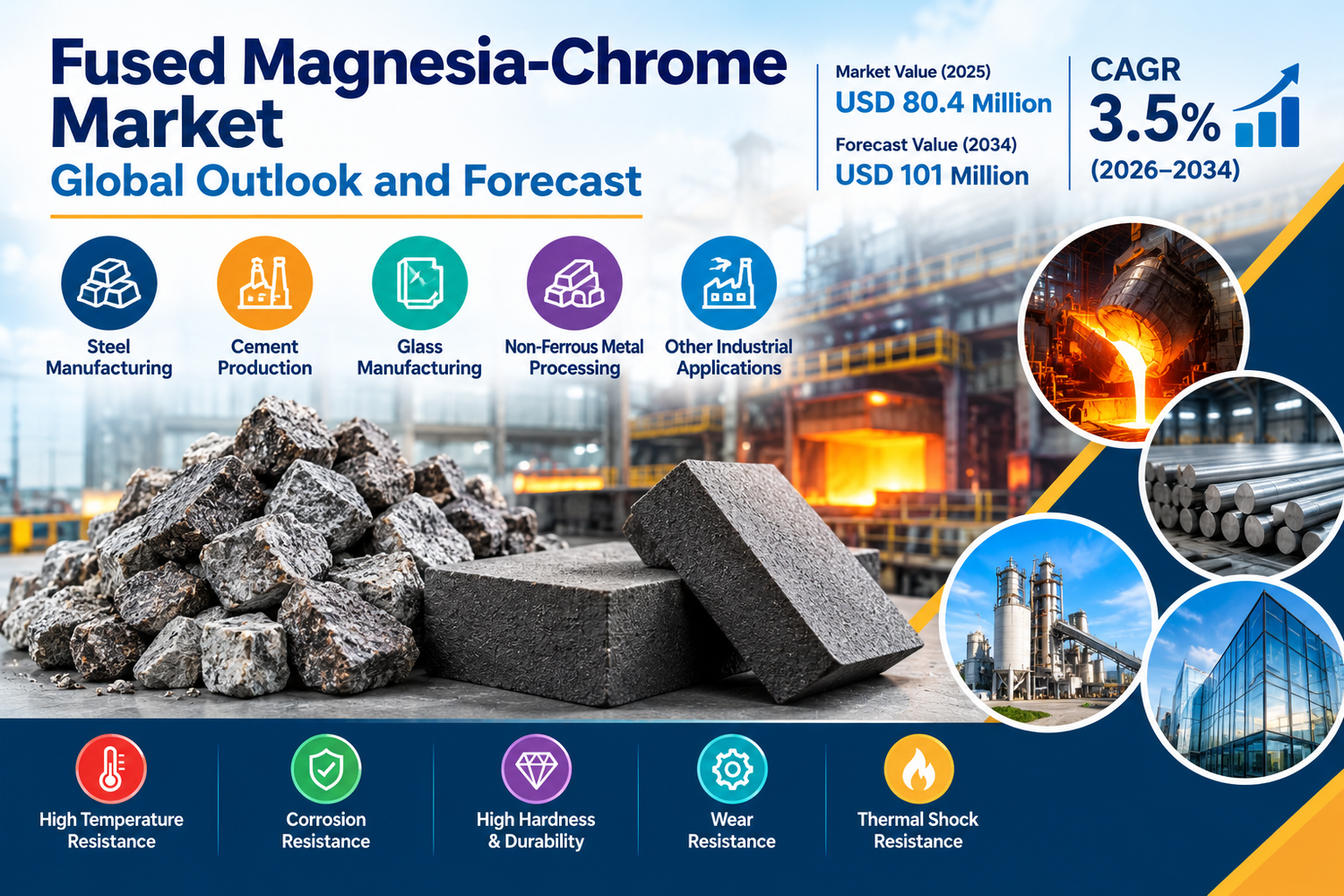
Fused Magnesia-Chrome Market to Reach USD 101 Million by 2034 at 3.5% CAGR

Global Fused Magnesia-Chrome Market is gaining attention across steel manufacturing, cement production, glass manufacturing, non-ferrous metal processing, and other high-temperature industrial applications. Fused magnesia-chrome is a high-performance refractory material produced through an electric melting process and primarily composed of magnesium oxide and chromium oxide. Its resistance to thermal shock, corrosion, and abrasion makes it suitable for demanding furnace environments where conventional refractory materials may not provide sufficient durability.
According to 24ChemicalResearch, the global Fused Magnesia-Chrome Market was valued at USD 80.4 million in 2025 and is projected to grow from USD 80.4 million in 2025 to USD 101 million by 2034, registering a compound annual growth rate (CAGR) of 3.5% during the forecast period. Growth is supported by steel industry demand, industrial infrastructure development, and the need for refractory materials that can withstand extreme temperatures and corrosive operating conditions.
Read the Complete Fused Magnesia-Chrome Market Report:
https://www.24chemicalresearch.com/reports/304101/fused-magnesiachrome-market
Market Overview
Fused magnesia-chrome is a specialized refractory material manufactured through high-temperature electric fusion. Its magnesia-chromite spinel structure provides resistance to thermal shock, chemical corrosion, and mechanical wear. These characteristics make it useful in industrial equipment exposed to extreme temperatures and aggressive operating environments.
The steel industry is a major source of demand, particularly for furnace linings and other refractory applications in steelmaking operations. Cement kilns, glass furnaces, and non-ferrous metal smelting operations also use high-performance refractory materials to maintain operational stability and extend equipment service life.
The market is influenced by industrial production, raw material availability, manufacturing costs, and environmental regulations governing chromium-containing materials. While demand for high-performance refractories supports market development, manufacturers are also exploring low-chrome and chrome-free alternatives to address environmental concerns.
Key Market Growth Drivers
1. Expansion of Steel Production
The steel industry is a primary driver of demand for fused magnesia-chrome. Steelmaking operations require refractory materials that can withstand high temperatures, molten metal exposure, and corrosive slag conditions. Fused magnesia-chrome is used in demanding furnace applications where lining durability is important for production continuity.
Continued investment in steel manufacturing and industrial infrastructure supports demand for specialized refractory products.
2. Advancements in Refractory Technology
Improvements in refractory formulations and manufacturing processes are helping manufacturers enhance thermal shock resistance, corrosion resistance, and structural stability. These improvements can extend refractory lining service life and reduce the frequency of maintenance interruptions.
Manufacturers are also focusing on raw material quality and production-process optimization to meet the demanding requirements of modern industrial furnaces.
3. Demand from Cement and Glass Manufacturing
Cement kilns and glass furnaces operate under high-temperature conditions that require durable refractory linings. Industrial expansion and equipment maintenance needs support demand for materials that can resist thermal stress and chemical attack.
Fused magnesia-chrome offers performance characteristics that make it relevant to selected applications within these industries.
4. Growth in Non-Ferrous Metal Processing
Copper, nickel, and other non-ferrous metal processing operations involve aggressive thermal and chemical environments. These conditions create demand for refractory materials with strong corrosion resistance and reliable performance.
As industrial metal processing expands, specialized refractory products can benefit from additional application opportunities.
5. Infrastructure Development in Emerging Economies
Industrialization and infrastructure investment support the construction and operation of steel plants, cement facilities, and metal-processing installations. These facilities require refractory materials for furnace construction, maintenance, and replacement.
Growing industrial activity in Asia-Pacific and other developing markets creates opportunities for suppliers serving these applications.
Manufacturing Costs and Market Challenges
Raw Material Price Volatility
Fused magnesia-chrome production depends on raw materials such as magnesite and chromite ore. Changes in material availability, mining conditions, and supply-chain costs can affect manufacturing expenses and profit margins.
Manufacturers must manage procurement and production planning carefully to maintain consistent supply and pricing.
Environmental and Health Regulations
Environmental and worker-safety requirements related to chromium-containing materials create challenges for manufacturers. Concerns about hexavalent chromium and its potential environmental impact can increase compliance requirements for production, handling, and disposal.
Meeting these requirements may require investment in emission controls, safe-handling procedures, and production improvements.
High Energy Consumption
Electric fusion requires extremely high temperatures and substantial energy input. Rising energy costs can increase manufacturing expenses and affect the competitiveness of fused magnesia-chrome compared with alternative refractory materials.
Energy efficiency and process optimization are therefore important considerations for producers.
Competition from Alternative Refractories
The market faces competition from alternative materials, including magnesia-carbon and alumina-magnesia spinel refractories. These alternatives can be attractive where manufacturers seek to reduce chromium-related environmental concerns or meet particular furnace requirements.
This competition encourages fused magnesia-chrome producers to improve product performance and develop more environmentally responsible solutions.
Market Opportunities
Growth in Non-Ferrous Metal Industries
Copper, nickel, and precious-metal smelting operations require refractory materials that can tolerate demanding chemical and thermal conditions. Fused magnesia-chrome's corrosion resistance creates opportunities in applications where reliable furnace lining performance is essential.
Expansion in Emerging Industrial Markets
Industrial development and infrastructure investment can increase demand for refractory materials in steelmaking, cement production, and metal processing. Suppliers that can meet local technical requirements and maintain reliable delivery may benefit from expanding industrial activity.
Development of Low-Chrome and Chrome-Free Alternatives
Environmental concerns are encouraging research into alternative refractory formulations. Manufacturers that develop products with improved environmental profiles while maintaining suitable high-temperature performance may be able to address evolving customer and regulatory requirements.
Improvements in Manufacturing Efficiency
Advancements in electric fusion, raw material processing, and quality control can help improve product consistency and performance. More efficient manufacturing processes may also help producers manage energy use and operating costs.
Market Segmentation
By Type
CrO3 Content Below 20%: This segment covers products with lower chromium oxide content. Such formulations may be suitable for applications where specific performance requirements and cost considerations influence material selection. Demand for lower-chrome products may also be influenced by environmental concerns surrounding chromium-containing refractories.
CrO3 Content 20–30%: This category includes products with higher chromium oxide content within the stated range. These materials are associated with demanding applications requiring strong corrosion resistance and high-temperature stability.
By Application
Steel: Steelmaking is a major application for fused magnesia-chrome. Refractory materials are used in equipment such as basic oxygen furnaces, electric arc furnaces, and ladles, where they must withstand thermal shock and corrosive conditions.
Cement: Cement manufacturing uses refractory materials in high-temperature kiln operations. The durability of furnace and kiln linings is important for maintaining production efficiency and reducing maintenance interruptions.
Glass: Glass manufacturing requires refractory materials capable of tolerating high temperatures and chemical exposure. Fused magnesia-chrome can serve selected applications where these performance characteristics are required.
Non-Ferrous Metals: Copper, nickel, and other metal-processing operations may require refractories with strong resistance to corrosion and thermal stress.
Others: This category covers additional industrial applications requiring high-performance refractory materials.
By End User
Heavy Industry Manufacturers: These include steel producers and large-scale metal-processing companies that rely on durable refractory linings to maintain operational continuity and control maintenance costs.
Refractory Product Fabricators: These businesses manufacture refractory products and components for industrial furnace and kiln applications.
Industrial Plant Maintenance and Services: Maintenance and service providers support refractory installation, inspection, repair, and replacement across industrial facilities.
By Manufacturing Process
Electric Fusion: Electric fusion is the predominant manufacturing process identified in the report. It produces a dense, fused material designed to provide resistance to thermal shock, slag attack, and structural damage under demanding conditions.
Sintering: Sintering is another manufacturing method included in the report's segmentation. It involves processing material under controlled conditions to achieve the required physical properties.
Rebonded or Synthetic Processes: These approaches represent additional manufacturing categories used to produce refractory materials for specific application requirements.
By Product Form
Bricks and Shapes: These products are manufactured in forms designed for particular furnace geometries and operating conditions. They are used in refractory linings where installation requirements and reliable high-temperature performance are important.
Granules and Grits: Granular products can serve as inputs or components in refractory manufacturing and other specialized industrial applications.
Powders: Powder forms support selected manufacturing and refractory formulation requirements.
Regional Outlook
Asia-Pacific
Asia is a key market for fused magnesia-chrome, supported by substantial steel production, industrial manufacturing, and demand for refractory materials. China plays an important role in regional production and consumption, while industrial development in India and Southeast Asia provides additional growth opportunities.
The region also benefits from established manufacturing networks and access to raw materials used in refractory production.
North America
North America represents a mature market supported by established steel and non-ferrous metal industries. Demand is associated with the maintenance and replacement of refractory linings, as well as requirements for materials that can perform reliably under extreme operating conditions.
Europe
Europe's market is supported by steel, glass, cement, and other advanced manufacturing industries. Product quality, technical performance, and environmental requirements influence material selection and manufacturing practices.
Environmental regulations also encourage the development and evaluation of alternative refractory formulations.
South America
Demand in South America is associated with steel production, industrial activity, and infrastructure development. Brazil and Argentina are among the markets relevant to regional industrial demand.
Middle East and Africa
The Middle East and Africa represent developing markets for refractory materials. Industrial diversification, steel production projects, and cement manufacturing investments can support demand for high-temperature refractory products.
Competitive Landscape
The global Fused Magnesia-Chrome Market includes established refractory manufacturers and specialized producers competing through material quality, technical expertise, manufacturing capabilities, and product performance.
Key companies identified in the report include:
-
Saint-Gobain
-
KROSAKI
-
SHINAGAWA
-
YOTAI REFRACTORIES
-
TAIKO Refractories
-
Washington Mills
-
PENNEKAMP Middle East
-
Msia Refractory Limited
-
Liaoyang Chenglong Mineral Products
-
Haicheng Baojin Refractory Material
-
Haicheng City Rongli Magnesia
-
Yingkou Jiamei Refractories
Competition is influenced by product consistency, resistance to demanding furnace conditions, technical support, manufacturing efficiency, and the ability to meet customer-specific requirements.
Established manufacturers benefit from their experience in refractory materials and relationships with industrial customers. At the same time, environmental requirements and demand for improved performance are encouraging continued product development.
What Does the Report Cover?
The Fused Magnesia-Chrome Market report provides analysis of market size, historical performance, forecasts, segmentation, regional demand, and the competitive landscape.
The report covers:
-
Global market size and forecasts through 2034
-
Historical market data and projected revenue
-
Segmentation by chromium oxide content
-
Application analysis across steel, cement, glass, non-ferrous metals, and other industries
-
End-user segmentation
-
Manufacturing process analysis
-
Product form analysis
-
Regional and country-level market analysis
-
Company profiles and competitive positioning
-
Sales, revenue, pricing, and production analysis
-
Capacity and capacity-utilization analysis
-
Production cost and gross-margin analysis
-
Import, export, and regional trade analysis
-
Market drivers, restraints, challenges, and opportunities
Key Report Highlights
-
Market Size: USD 80.4 million in 2025.
-
Forecast Market Size: USD 101 million by 2034.
-
CAGR: 3.5% during the forecast period.
-
Major Growth Driver: Demand from steel production and high-temperature industrial processes.
-
Key Product Types: CrO3 content below 20% and CrO3 content of 20–30%.
-
Major Applications: Steel, cement, glass, and non-ferrous metals.
-
Manufacturing Processes: Electric fusion, sintering, and rebonded or synthetic processes.
-
Product Forms: Bricks and shapes, granules and grits, and powders.
-
Key Challenges: Raw material price volatility, energy costs, environmental regulations, and competition from alternative refractories.
-
Growth Opportunities: Industrial expansion, non-ferrous metal processing, manufacturing improvements, and the development of low-chrome or chrome-free alternatives.
Frequently Asked Questions
1. What is the current size of the Fused Magnesia-Chrome Market?
The global Fused Magnesia-Chrome Market was valued at USD 80.4 million in 2025.
2. What is the projected market size by 2034?
The market is projected to reach USD 101 million by 2034.
3. What is the expected CAGR?
The market is expected to grow at a compound annual growth rate of 3.5% during the forecast period.
4. What is fused magnesia-chrome?
Fused magnesia-chrome is a high-performance refractory material produced through electric fusion. It is primarily composed of magnesium oxide and chromium oxide and is used in demanding high-temperature industrial environments.
5. What are the main factors driving market growth?
Key drivers include steel production, demand for durable refractory linings, improvements in refractory technology, and industrial infrastructure development.
6. Which industries use fused magnesia-chrome?
The main application industries include steel, cement, glass, and non-ferrous metal processing.
7. What are the main market challenges?
Major challenges include fluctuating raw material costs, energy-intensive manufacturing, environmental and health regulations concerning chromium, and competition from alternative refractory materials.
8. Which companies operate in this market?
Companies identified in the report include Saint-Gobain, KROSAKI, SHINAGAWA, YOTAI REFRACTORIES, Washington Mills, PENNEKAMP Middle East, and other specialized refractory manufacturers.
9. What opportunities are emerging in the market?
Opportunities include growing demand from non-ferrous metal processing, industrial development in emerging economies, manufacturing improvements, and the development of low-chrome or chrome-free alternatives.
Complete Report
For detailed market estimates, segmentation, regional analysis, competitive information, and forecasts, read the complete report:
https://www.24chemicalresearch.com/reports/304101/fused-magnesiachrome-market
About 24ChemicalResearch
24ChemicalResearch provides market research and industry analysis covering market size, demand trends, competitive landscapes, segmentation, and forecasts across chemical, materials, and industrial markets.
Contact Us
Website: https://www.24chemicalresearch.com/
Phone: +91 9169162030
Email: help@24chemicalresearch.com